by admin | Nov 16, 2015 | Uncategorized
When you become a parent something inside shifts. It happens slowly over time but it undoubtedly happens. People without children are free to act as they wish. They don’t have to pretend for the sake of the kids. For example, when I was a single person and I would stub my toe I could run around the room screaming and cursing until the pain had subsided. But now I have to hop around moaning quietly so as not to scare the children. Cursing is out of the question. I used to be able to sit on the couch and eat a box of Cap’n Crunch for dinner while watching an afternoon of The Real World reruns. Now I have to pretend like TV is the enemy and keep it off most of the time. I feel like I have to maintain order and act like an adult.
While these changes are subtle they undoubtedly exist. I feel more like a mother now than I did when the kids were young. I used to feel like I was pretending to be the responsible mother. Now I actually feel like the mother. For better or worse, a piece of me–who I was uncensored–is gone.
But every now and then a little tiny nugget of the real me is forced out. One time I let out a cursing rant when I accidentally backed the car into a pole. Another time I lost my composure when I was treated badly in a doctor’s office. Both times I forgot my mom self and acted like my real human self. I lost my composure, and I showed the kids a side I wasn’t proud of.
In the past I only let my guard down inadvertently. It would just happen by accident when I was pushed to my limit. I would never choose to act that way. Or would I?
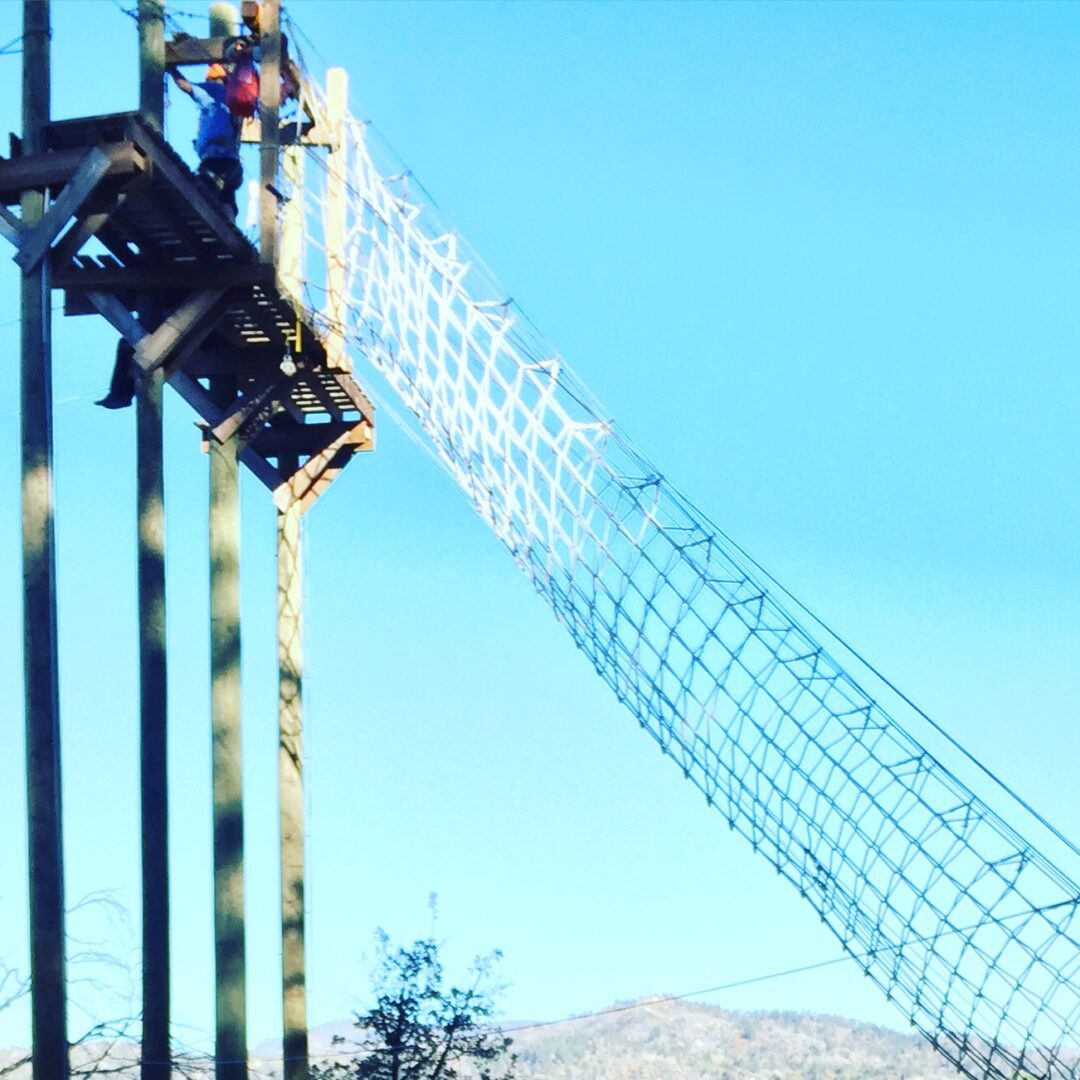
This weekend I had an opportunity to go zip lining with my daughter. I am extremely afraid of heights and falling. I can get vertigo in a roller rink. I tend to play it pretty safe. So the idea of climbing up a tall rope wall to sit on the edge of a tiny wooden platform, then hurl myself down a giant cord over a ravine sounded torturous. And yet, I found myself following my daughter up the hill to participate with her. She could have done it herself, so why did I feel the need to push my limits? If I were alone I would never have given the zip line another thought.
But as we rounded the hill to the launch site I realized exactly what I was doing. I was being vulnerable. I was going to be afraid, and I was going to do it in front of my daughter. I would let down that wall and show her that I, too, get anxious. And instead of cowering on the ground watching her, I wanted to do what scared me for her sake.
I push my daughter to face her fears constantly. I don’t want her to feel she can’t do something. She shouldn’t let anxiety hold her back. We have learned that the best way to conquer fear is with positive self-talk. Tell yourself you can do this. Ask yourself what is the worst that could happen? And envision yourself doing it and being successful. It is so easy to tell my daughter what to do when I am not the one who is scared.
So we got outfitted with the harness, helmet and ropes. We did a practice run, and I felt confident–maybe even a little excited. But as I climbed that rope wall, higher and higher, my fears escalated. I wanted to back out. My daughter was climbing below me and quickly gaining ground. This was so easy for her. I was simultaneously panicked and proud that she could conquer this without fear. My resolve was wavering, but I hadn’t backed down.
We both reached the tiny platform at the top of the zip line around the same time. At this point I was no longer a mom. I could not take care of my daughter because I was a petrified woman with tunnel vision. I was shaking with fear of death. Before I could zip anywhere workers hooked me up to the line. My feet were dangling and all I could see was the long rope and the cavernous drop. I didn’t want to do it. I wanted to back out. But there was my daughter. And she said, “Mom, you can do it!”
And then I heard “One … Two …” I told myself, “You can do this. Do it for your daughter so you can look her in the eye and honestly ask her to face her fears too.” And with the three! I launched myself off the tiny platform. Euphoria immediately set in. I was zipping through the air looking at my daughter zipping next to me. It was a moment I will be unable to forget, and I hope she doesn’t either.
For once I let my daughter behind the curtain. I wasn’t supermom. I had flaws and fears and insecurities. I didn’t hide them from her. And when she saw these traits in me, she wasn’t unnerved. She supported me like I supported her.
That day I really enjoyed my time with my daughter in a way that parents of tweens often don’t. I know it was because for once I came undone. We were in it together and we are both better off for it.
by admin | Oct 19, 2015 | Blog, Catherine's Picks

Today’s parents are not just parents. They are coaches and referees and umpires. I don’t mean the kindhearted people who volunteer their time. I’m talking about the parents on the sidelines. As parents, we don’t just watch our children play sports any more. We are in the game.
Lately I have been focusing on how parents behave at my kids’ games. I have seen some ugly behavior. So many moms and dads have no qualms about yelling at umpires who are only behind the plate because no one else volunteered. I recently saw a parent scream at his kid, “Come on! You can do better!” The child was 8.
I never viewed myself as that kind of mother. For the first few years of parenting my husband and I avoided organized sports. Our kids weren’t competitive killers chomping at the bit to play on a team, and we were plenty psyched to keep our weekends together as a family.
Inevitably, though, our kids decided they wanted to get in the game. My son played baseball and basketball. My daughter, who never cared much for sports, was strongly encouraged (by us) to find a healthy physical activity. She chose water polo–a game we knew nothing about.
Three times a week I watch my daughter in the pool and twice per week my son is on the field. After seeing the craziness many parents bring to youth sports, I was determined not to join the insanity. I wasn’t going to yell or advise. I wasn’t going to praise every minute play or action. My plan was to simply enjoy watching them enjoy themselves.
Only I couldn’t. As much as I tried, I still found myself shouting. I wanted my daughter to swim more aggressively. I wanted my son to put his hand behind his back while catching. He should swing through the ball more. She should call for the ball more. Blah blah blah. I became so disgusted with myself that I became determined to sit at a game and say not utter word of advice. But, well, I couldn’t do it. I failed. Repeatedly.
And then, in eight minutes, I was cured.
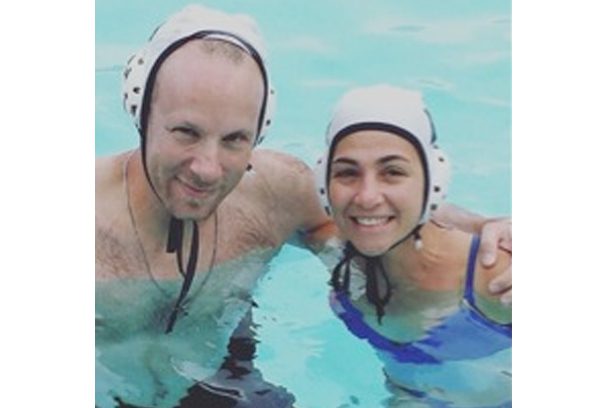
My daughter’s water polo team had a family polo game, kids against parents, yesterday morning. My husband and I suited up, put on the ridiculous headgear and eagerly jumped in. The old folks warmed up for a minute and tried to stay afloat. Everyone was laughing, giggling, having a fun ol’ time. Then, one second after the initial whistle from the coach, it became clear this was no laughing matter. We had to swim back and forth and back and forth. I could barely keep my head above water while trying to throw the ball. Another player nearly drowned me, appropriately, trying to get the ball (She’s 9). After three minutes I was tempted to tap out.
I didn’t, and wound up playing a whole eight minutes. I didn’t do the team’s requisite 20 laps as a warm up, and I didn’t practice for another hour after that. Eight minutes total. As I clumsily slogged out of the pool, deprived of breath and barely able to pull my own body weight, I realized I had no business telling my daughter what to do in the water (and there is no added benefit to nitpicking my son’s game, either).
My kids are not playing sports for the scholarship potential. There is absolutely no justified reason I need to coach them from the sidelines. The only outcome I can see is that they get so sick of hearing my commentary that they stop playing. I read in a recent survey that 70 percent of kids stop playing sports by 13. I can see why. There is so much pressure even without comments from the bystanders. From now on I am a spectator. I am not there to help my kids get better or stronger or more adept at the game. I am not there to teach the coach or the umpire how to do their jobs. I am simply going to enjoy the game, keep my big mouth shut …

by admin | Oct 15, 2015 | Uncategorized

Last week the students at Aliso Niguel High School in Aliso Viejo, Cal. were rightly euphoric.
They learned that their school won the Chegg + Macklemore & Ryan Lewis voting contest on Chegg.com. The hip-hop superstars–whose song “Downtown” is the duo’s fifth Top 20 hit on the Billboard Hot 100 List–would come to Aliso Niguel High to lecture on the entertainment and music industry. And that wasn’t all. Along with the celebrity appearances, the school’s meager music budget would receive a needed boost with a $10,000 David B. Goldberg Music Grant. Chegg.com is an educational website whose mission is to ensure that all student have access to higher education and low-cost tutoring and books. The music grant was named for the beloved late CEO of Survey Monkey, who passed away earlier this year.
If you’re Aliso Niguel High, this sounds great, right?
Well, you would think. The student body excitement came to an abrupt halt when the principal, Deni Christensen, cancelled the event and declined the donation after several parents complained that Macklemore and Lewis promote “alcohol and drug use and misogyny in their music.”
While the duo does, indeed, have songs that aren’t exactly clean, they’re best known for the powerful song “Same Love” about marriage equality.
The students and community rallied on Instagram, Twitter (#bringmackback), and created a Change.org petition to put pressure on the administration. In less than 24 hours, 8,713 people signed petition. After careful consideration of the various points of view, Christensen–to her credit–reversed her decision and will accept the donation and hold the lecture (permission slips from parents will be required).
Problem solved, case closed. Right?
Um, no.
There’s a problem here. A big one. And it’s not specific to Aliso Niguel High, or Seattle-based hip-hop artists. In the culture of Tiger moms and helicopter parenting, mothers and fathers and even educators have taken the concept of protecting children to a whole new level by trying to shield kids from any perceived inappropriateness. The problem is that censoring doesn’t protect children. It often has the opposite affect.
When people, especially teens, are told they can’t see a disturbing picture or shouldn’t read a particular book, their desire only intensifies. That’s why my friends and I ran to the library in the 1980s to secretly check out Judy Blume’s book Forever and why Harper Lee’s To Kill A Mockingbird has sold more than 30 million copies.
It’s noble for parents to care to control the media messages with which children are bombarded on a daily basis. But they can’t shield them from every objectionable phrase and song and film. It’s impossible. Not only do 95 percent of American teens have Internet access, but their online access is no longer tied to a desktop in the family room. Smart phones are ubiquitous. If your daughter doesn’t have one, her best friend does.
Once kids know their parents are strictly trying to censor information from them it becomes clear that those topics are off limits for discussion. Without the ability to discuss what they find on the Internet with their parents teens are left to decipher all sorts of confusing information sans supervision.
Lastly, freedom of speech isn’t some tired old cliché. It is an essential amendment of the constitution that resonates with young people. If not for the ability to speak out we might still have segregation. Women probably wouldn’t be able to vote. And the gay and lesbian couples would still be relegated to partnerships without the legal benefits of marriage. Limiting knowledge, even if one disagrees with it, leads to ignorance. And ignorance leads to racism and disapproval of difference. Furthermore, critical and analytical thinking are key outcomes of the new common core standards being adopted in school districts across the country. Students can’t think critically without being exposed to both sides of an argument.
Schools are prime grounds for debate about what kids should learn. Some parents would prefer evolution and climate change be omitted from the curriculum. Sexual education is prohibited in certain schools, too. But without the ability to create a dialog about controversial issues and without exposing children to that dialog we risk raising children who are devoid of opinions.
Last week I took my tween daughter and her friend to the opening of the movie He Named Me Malala. It is the story of a Pakistani girl who publically spoke out against the Taliban policy that banned girls in schools. Being threatened, shot, and nearly dying didn’t stop her. She is now the face of a movement to provide access to education for girls and the youngest winner of the Nobel Peace Prize. Malala learned to advocate after countless discussions with her educator father. Those discussions fueled her passion to make the world a better place for herself and girls around the globe.
Let’s not take that passion from our children in the vane of protecting them from distasteful messages. Instead when controversial topics arise parents should talk to their teens about the family’s viewpoint and values. Parents should be open to the discussion and allow for a variety of opinions. That process, the one where young people have a voice based on all the information available, is the only way to protect our kids and community.
by admin | Aug 28, 2015 | Blog
My daughter’s middle school started up again earlier this week, and–as always–there was a flurry of forms for me to read and sign. This sheet asked for permission for the children to walk off campus with their teacher. OK, fine. That sheet made sure parents understand students will only receive 50% credit on tardy work. Yikes– harsh, but understandable.
So I was signing paper after paper after paper when my pen came to an immediate stop. Before me, in very plain language, was a policy that, at best, can be termed barbaric, potentially dangerous, and incredibly insensitive. In fact, I was so shocked I had to read it again. So I did …
“Students will be allowed to use the hall pass a maximum of 3 times per quarter. However, each use of the hall pass will cost the student 3 extra credit points. You will keep an individual hall pass log which must be presented each time a hall pass is issued. A lost log prevents the issuing of a hall pass and the awarding of any points. ”
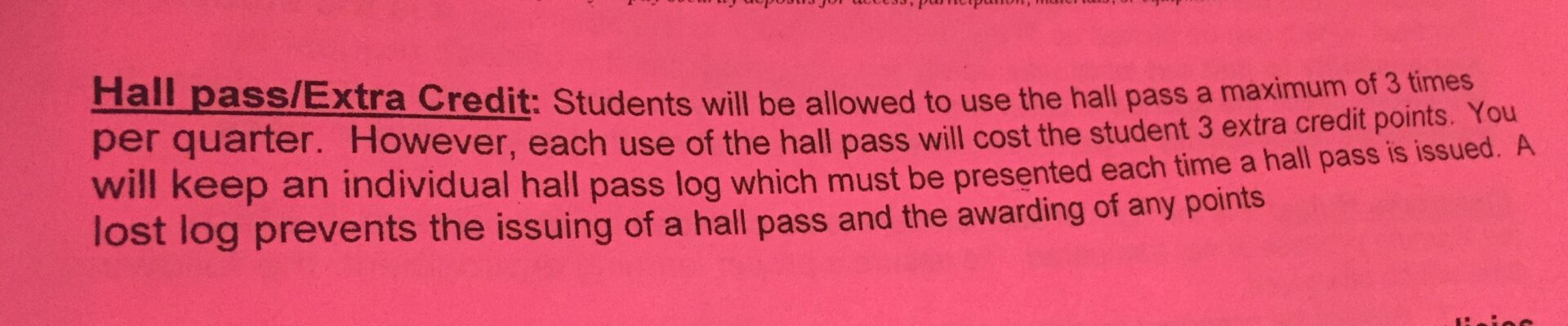
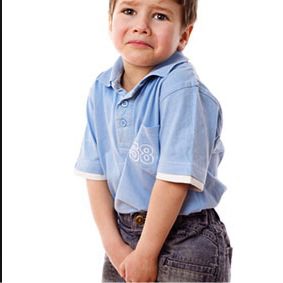
Just in case there’s any confusion, by daughter’s school awards extra points for students who don’t use the toilet during class. In other words, if my child needs the bathroom when her body naturally tells her it is time, she will be penalized by receiving a lower grade.
I am dumbfounded.
Yes, surely teachers become sick and tired of students leaving class to dilly-dally in the hallways. It can be disruptive and annoying, and the kids might miss important lessons during their absences. However, what’s more distracting than sitting at a desk, squirming left and right, desperate to relieve oneself. While this policy may prevent hallway misadventures, it penalizes students who might actually need to use the bathroom.
Furthermore, the policy can have very serious side effects outside the classroom. Generally beginning in middle school, girls menstruate every month. There is no telling when the moment will strike. And there are often mishaps in management–particularly with youngsters learning how to handle the monthly flow. Teachers (especially female ones) should understand that delaying a trip to the bathroom is tantamount to branding girls with a scarlet letter.
Severe medical consequences can also arise from restrictive restroom policies. Children are more likely to have urinary tract infections, incontinence and chronic constipation. Children are struggling with constipation at near epidemic proportions, with some studies suggesting up to 30 percent of school-aged children affected. The cost for heath care and treatment for children with constipation is estimated at nearly $4 billion per year.
One common cause of constipation is withholding when the body signals it is time to go. A common side effect is encopresis, which is when a child involuntarily leaks stool. This can be humiliating, to say the least. Furthermore, typical treatment includes the use of laxatives that permit children to eliminate several times a day. Restricting bathroom access is going against the medical advice of any pediatric gastroenterologist.
While these policies are clearly damaging, they are sanctioned by school administration. Teachers and principals are under increased pressure to teach more, have students test better and outperform so classroom teaching time is precious. The problem is this policy is also against education law, as least it is in California where my children attend school.
The issue of students frequently leaving the classroom can easily be rectified without such insensitive policies. Some schools ask parents to provide doctor’s notes for students who require more flexibility. This is ludicrous and embarrassing for students who may already be bashful about their condition. Teachers should require students to sign in and out each time they use the restroom. If a pattern emerges the teacher can intervene by discussing the lost learning time with the student. Teachers can also refer students to the school nurse as needed.
Don’t make the vast majority of students suffer because some children use the hall pass as a chance to escape the classroom. Err on the side of children who are responsible and need the restroom, and deal with the abusers as they come. I wouldn’t put up with this policy at work and our kids shouldn’t have to in their schools.
by admin | Jul 17, 2015 | Blog, Catherine's Picks, Toy Reviews
Lego Ideas: Birds
$44.99
Manufacturer recommended age: 12 – 15 Years (Done by my 8 yo and 11yo with little supervision)
The other day my son and I were wasting a little time in the Lego store. He loves to look at all the sets, and I kind of do too. Lego now has this really cool imaging television. You hold up any set that has more than 250 pieces and it brings it to life. It literally shows you the models all built and moving around on the box. It is incredible.
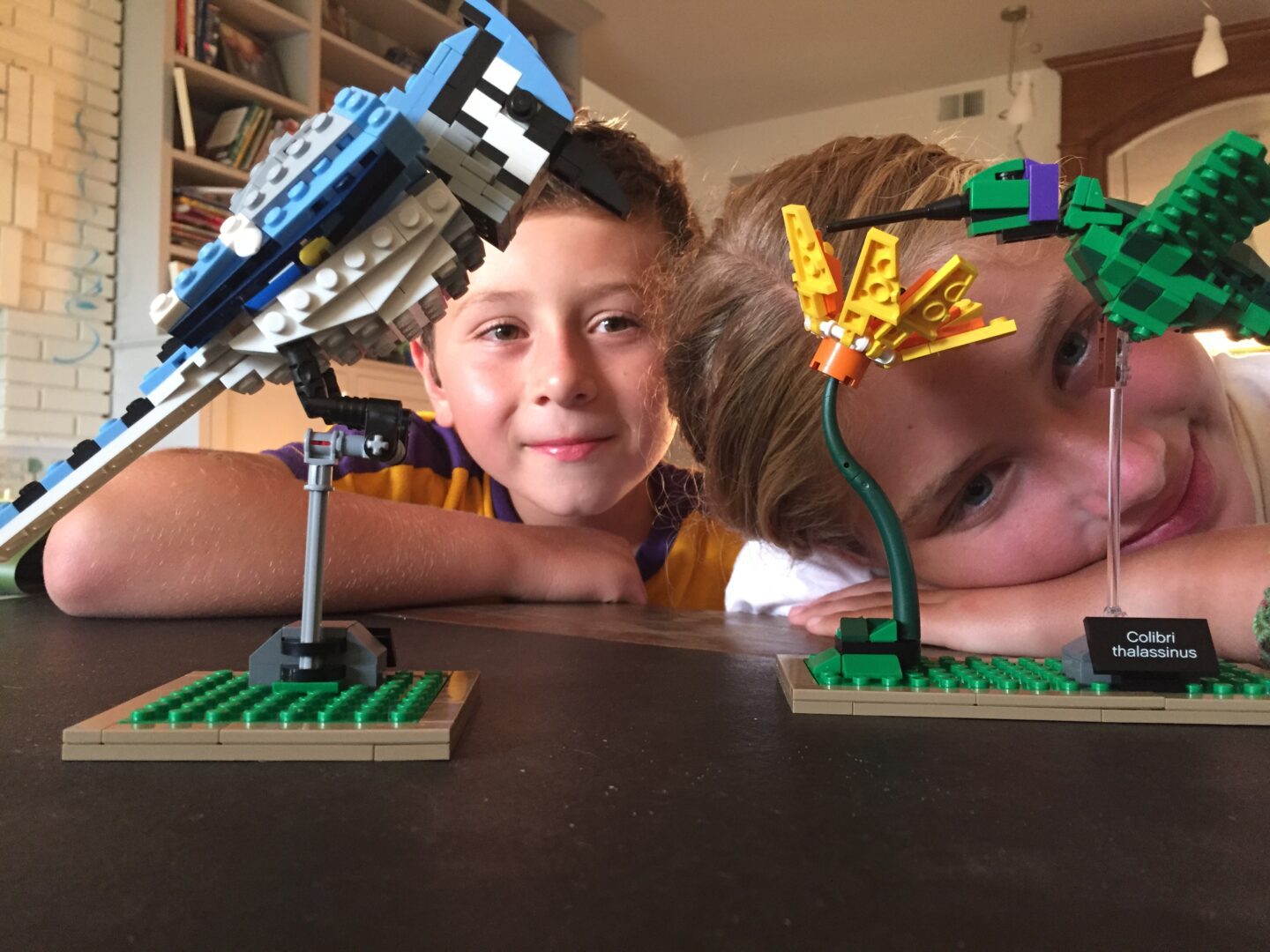
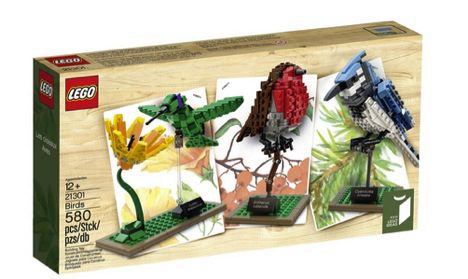
So while he took every set in the store up to the TV screen I checked out a few sets. One caught my eye. The Lego Bird set contains a hummingbird and flower, a gorgeous blue jay and a red-breasted robin. I love those birds. Actually I am kind of obsessed with them. So I did something I never do. I bought the set for no reason. Not as a surprise. Not as a birthday gift. Just for me to do with my son for fun.
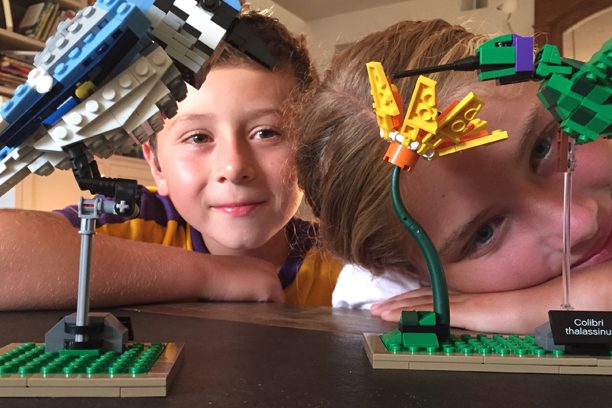
Turns out the entire family loved the project. My daughter who doesn’t play with Legos often got inspired to build the hummingbird. Not only that she decided she needed more Legos in the future. Score!
Here’s my review:
Pros:
Fairly quick to build
Beautiful realistic looking birds, nicely displayed
The wings and heads move in awesome ways
Good for a girl or a boy or a kid or a grown up
Cons:
Fairly quick to build (Yup, this one is a pro and a con)
Delicate. This isn’t a Lego set your little ones can “play with” after it is built. It is more of a show piece
On a side note, this Lego set is part of Lego Ideas. Lego enthusiasts are allowed to make up anything they want, build it, take loads of pictures and then pitch it to Lego. People in the community vote on it and if it gets enough votes Lego reviews it. If Lego decides to build it the original designer gets 1% of the profits. That’s really really cool. And that is why this set is different. It was build by a guy who loves birds. Not just Lego. Check out some of the other ideas currently in the review process here.
