by admin | May 1, 2016 | Blog
I’m a social worker. I’m a mom. I’m a family coach. And I’m, um, maybe, a writer? I have been working on my writing for eight years. I’ve had some success and some embarrassing flubs and loads of rejections. It’s all part of the learning process. Because I’m new to the blogger scene I’ve never been to a conference. But when I saw Mom 2.0 was coming to my new hometown I decided to go to my first blogger conference. There were a few things I could learn from the bigwigs.
In the lead up to the conference I was inexplicably terrified. I’m a fairly confident person but not about my writing and not in a room filled with, oh, 700 of the best mommy bloggers in the country. So as the days grew closer my freak-out level mounted. I worried I would feel like a fraud. I convinced myself my clothes were hardly cool a decade ago. My haircut was too short and the color was turning orange. All of my insecurities were exploding.
But I’ve never been one to walk away from a challenge, so I went. And thank goodness. I didn’t simply survive Mom 2.0. I had a tremendous experience. Now that I’ve been through it, here are a few things I wish I knew before I dove in …
Everybody poops: There are some people at Mom 2.0 who are absolute superstars in their genre. They have tens of thousands or even hundreds of thousands of fans and followers. One woman I met has more than 1 million people on Pinterest following her pins. Wow! I heard so many prominent speakers say that while they have ________ (fill in the blank with an insanely high number of followers) on one social media platform, they only have 7,000 followers on Facebook or Twitter. In the world of blogging, followers are currency, and the richness of some can be shockingly overwhelming especially if you’re like me, and you’ve scratched and clawed your way to 5,000 followers. But then, just when you start feeling down, you enter the bathroom. And all those ladies who seemed superhuman five minutes ago are there. They pee and poop just like you do and you realize that, come day’s end, a person with 10 million Twitter followers is just like you: Human.
It doesn’t matter what you wear: I have slim pickings in my closet. I hate shopping and clothes never fit me (too big on top, too small on the bottom). In the weeks before the opening party, I heard people discuss their clothes and post wardrobe photos–and the private panic attack brought me back to middle school. I managed to pick out a few items that could pass as almost cool and felt at peace for two seconds. Then the weather turned windy and cold and I had to make last-minute changes. How would that go over? What would people think? Would I be an outcast? Eh, no. I wore jeans and sweaters for three days. No one gave a shit.
We all have insecurities: Blogging (and writing for that matter) is a singular activity done in the privacy of a bedroom or anonymity of a Starbucks. When we are writing we wear pajamas and our hair isn’t brushed. Most of the time there is a coffee stain or some bit of lunch on our shirts. Spending loads of time alone makes meeting up with a large group of people a wee-bit stressful. Everyone’s anxiety is raised right before Mom 2.0. Will I look good enough? Will the cool people talk to me? What if I say something stupid? Turns out everyone is nervous about something. But we are all good enough and cool enough, so we should stop worrying.
Not everyone has her best friend at Mom 2.0: Reading all of the Facebook posts it feels like everyone knows one another, and they are all the best of friends. I’m here to say that’s not true. Sure, some women are tight with bloggers and podcasters and influencers they met in past years. Yes, they can’t wait to see each other again after communicating online for a year. But there are way more who arrive flying solo and feeling like the only outsider. I met loads of friendly interesting women who were also looking to make connections because they too came alone.
If you say hello someone will say hello back. It’s that simple.
Don’t miss a meal: Chatting over a quinoa lentil salad somehow seems easier than walking up to a random person and starting a conversation. Look up from your cup of coffee every time someone new sits down and say, “Hi. Welcome to the table.” By the time you reach for your perfectly crafted Ritz-Carlton tiramisu demitasse you will have met eight new people. Now imagine meeting eight new people at every meal for two days. That’s a lot of new friends.
Wear a conversation starter: If you have a hard time meeting new people or initiating a conversation, wear an amazing necklace or color your hair pink or bump up your shoe choice. We are women, and we like to dole out compliments. Use that opportunity to open up the conversation and get to know another person.
Women at Mom 2.0 aren’t the mean girls we imagine in our heads: Somehow when a bunch of women get together we are reminded of high school. The cliques and gossip and mean comments about our weight are forever ingrained in our minds. But there is none of that at Mom 2.0. These ladies are nice. Not everyone became my new best friend but not one person was even remotely rude to me. Most of the time I felt like I was at a reunion from camp but I couldn’t remember the people.
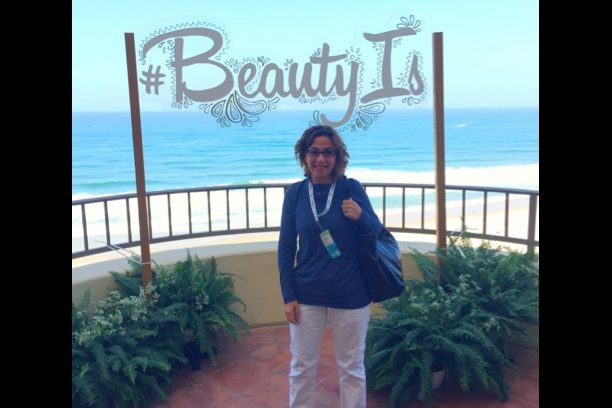
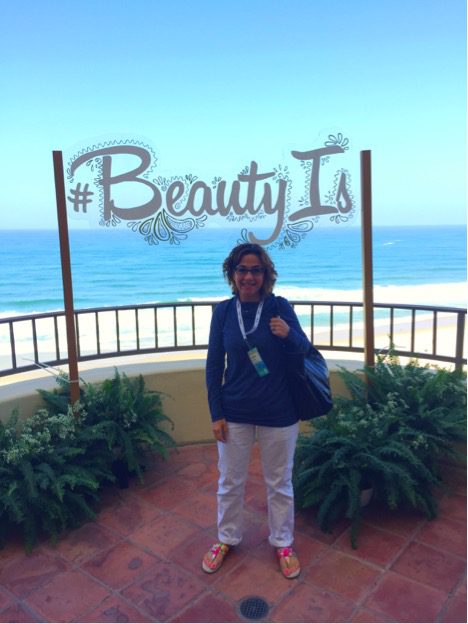
It won’t go as planned: On the morning of the first day of the conference I woke up with my eye swelled to the size of a golf ball. Maybe something got in it the night before as the wind kicked up. Or maybe I had some disgusting infection. I had no idea. But with that gross eye issue I knew that taking professional-looking headshots was out. Doing a taping for The Today Show was probably out too. And what’s worse my already shaky confidence took a nosedive. But then I heard Soledad O’Brien speak and with the Dove #Beauty Is signs surrounding me I decided not to let my eye derail me. I put on my broken glasses and walked right up to the Today Show producer and made my pitch. I took my picture at Kia anyway (It’s frightening). In the end I relaxed, met loads of new people and even though the summit didn’t go just like I imagined, it was perfect.
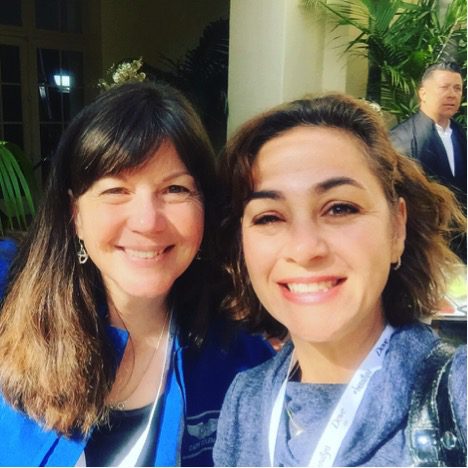
Astronaut Cady Coleman and My Swollen Eye
by admin | Feb 19, 2016 | Blog
I’m Jewish but not religious. Leaning toward agnostic, but hopeful I’m wrong, I’m more like Jew-ish when it comes to following the laws of the Bible. However, I still have a strong Jewish identity. To me, being Jewish is like being West Indian or Irish. It’s more of a culture.
I went to Hebrew school to learn prayers and songs and stories of the Jewish people. I hated it. We all hated it because it was foreign and boring. I learned to read a language in words only. No one taught me what any of it meant. After 11 years of religious education the only words I knew how to translate from Hebrew into English were Sheket Bevakasha–“Quiet children.”
Even before I had kids I knew I wanted to raise them Jewish. And I knew I wanted my children to have Bar and Bat Mitzvahs. Despite my shoddy Jewish education I had a Bat Mitzvah, too. My parents had been recently divorced and I didn’t want a big party or event. So my mom made a lunch at the house for family and a couple of friends and then we took a trip to Israel. Although my Bat Mitzvah didn’t feel like an especially religious moment in my life it was deeply important to connect me forever to the Jewish people. I had to learn to really read Hebrew. I had to learn the prayers that my people had been saying before and after the Torah reading for centuries. It was my first big accomplishment.
When my daughter was six we enrolled her in Hebrew school. This was the precursor to the Bat Mitzvah. Over the years she often loved and then hated Hebrew school for all the same reasons I did. And even though I could totally relate it became non-negotiable. She would learn about her people and she would have a Bat Mitzvah.
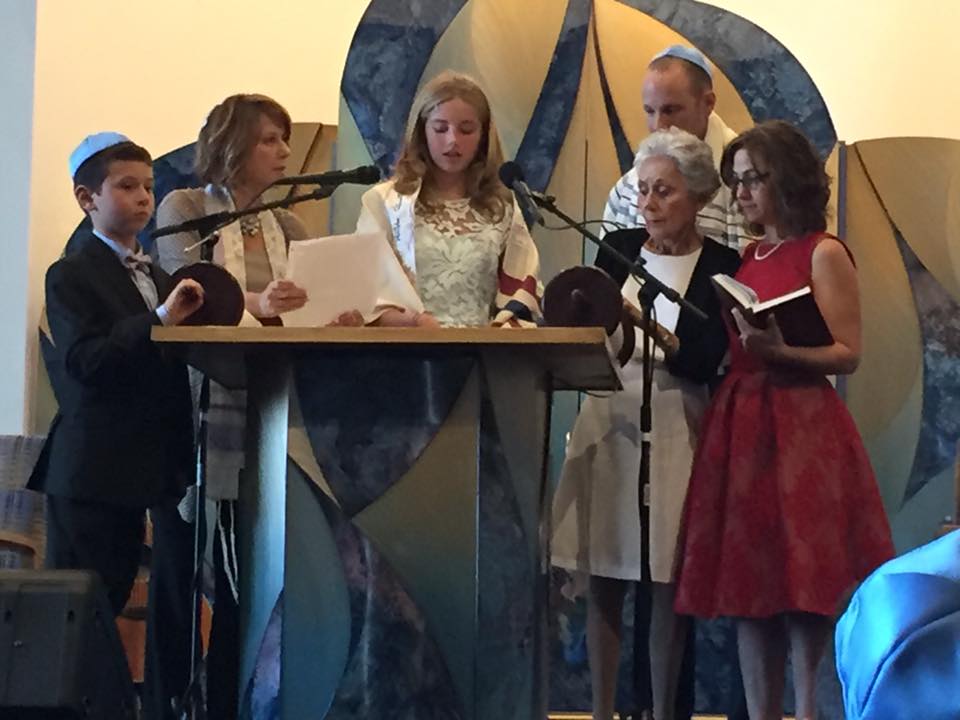
This past weekend was the culmination of her Jewish education, her Bat Mitzvah. Since we recently moved across the country we figured we would have the ceremony in the temple and celebrate on a very small scale with just our immediate family. But it ended up being so much more than that.
Family from New York, Florida and Chicago made the trip. In attendance were first cousins and second cousins and third cousins. We had parents and grandparents and even great grandparents there. Some of our closest friends and neighbors also made it to the event. Our immediate family extended into the vast village of people who helped raise my daughter.
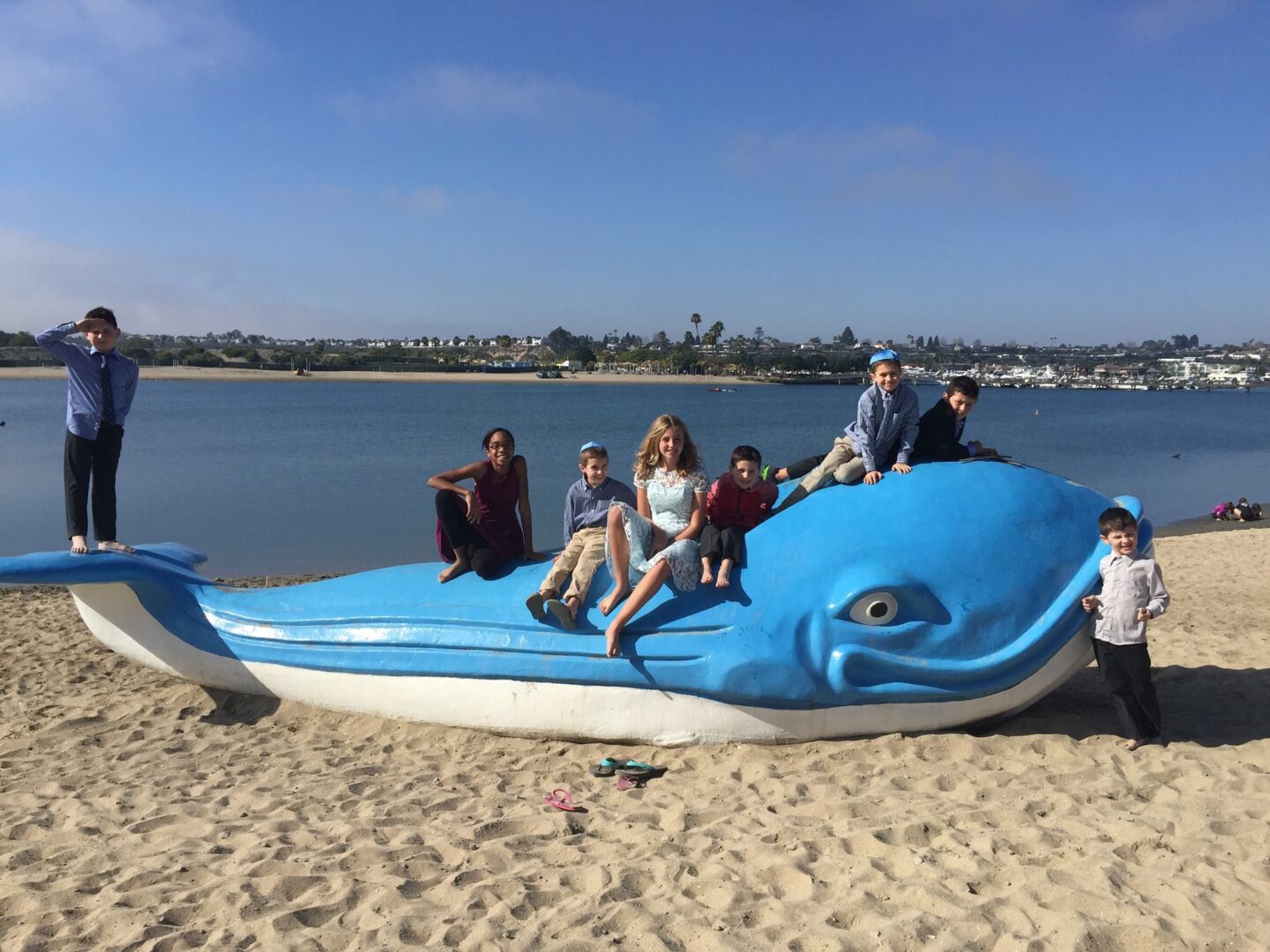
Every single thing for the weekend turned out perfectly. The weather held up despite the threats of an El Niño. No one got sick. The service and party went off without a hitch. Kids ran around barefoot in the sand. Girlfriends from school danced around and made silly faces for the photo booth. Adults gushed about how personal the rabbi made the service and about the cantor’s voice and about my daughter’s maturity.
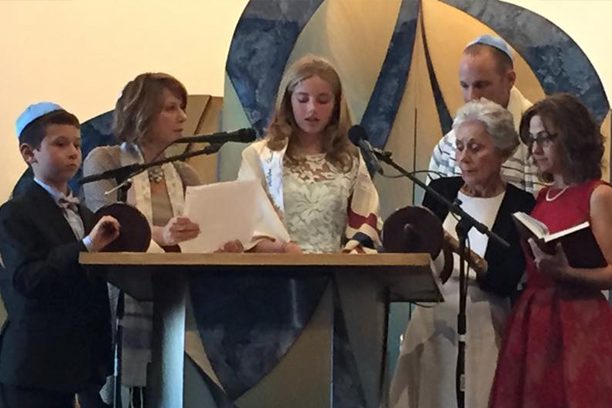
 In the end none of that really matters. The most meaningful moment in the entire weekend of festivities was when my daughter read her Torah portion standing on the bema with her 96-year-old great grandmother at her side. There was something about the continuity of the ritual that hit home for me. I don’t care if my daughter continues her Jewish education. I don’t really care if she visits Israel for her birthright trip. She now knows enough to enter any synagogue from Venice to Argentina to Russia and despite a fundamental language barrier she can still participate in the service in the language of her people.
Our home will still be sort of Jew-ish. We will celebrate all the holidays and continue traditions such as having a bris or the Passover Seder but none of us is particularly religious about those rituals. We do them because our people do them. I hope my daughter learned that this weekend and it connects her to the Jewish people for the rest of her life and the lives of her children and grandchildren and great grandchildren. I can’t explain why but that’s important to me.

by admin | Jan 26, 2016 | Uncategorized

Not too long ago I received an email asking if I wanted to try out some new snacks for free. The goal of the email was for me to taste the product and write a glowing review thus providing some nice advertising for the company. I like snacks and I especially like the free kind so I signed up.
A few weeks later my snack pack arrived. Quite honestly I was prepared to dislike these chips. I am all for healthy eating but the chips were pushing it with gluten free, vegan, kosher, low fat, non-GMO and baked. How could something with all of those restrictions actually taste good?
Well, they do taste good. Not just good but delicious and so satisfying. These chips are made from peas and corn with a bit of oil and salt. They are as crunchy as Doritos with none of the guilt. The chips are also dry to the touch which is different from other pea crisps that I have had. I tasted three varieties: Original, Sriracha and Aged White Cheddar. My favorite by far is the Original. The Sriracha was too garlicky for me but some will like that. The cheddar ones were tasty too but I preferred the plain ones.
What I really like about these chips is that they are really really crunchy and really healthy. One good-sized portion has only 2.5 grams of fat, 120 calories, 4 grams of protein and 1 gram of fiber. You really can’t beat that kind of nutrition in a snack.
My kids tasted the snacks and no one was particularly moved by them. But I think they might grow on at least my son. So the bottom line is that I got the snacks for free but now I am a believer. I will have to head to Whole Foods for my next supply.
Are you wondering how you too could get free snacks? If you want to try The Real Deal Veggie Chips for free here is your chance. Send your email address to me at Catherine@thefamilycoach.com and I will raffle off a package of chips. Happy snacking!

by admin | Dec 12, 2015 | Uncategorized

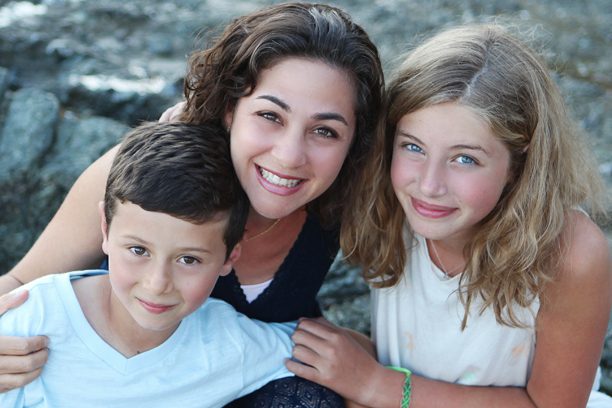
Photo credit: Noel Besuzzi
A few weeks ago Mark Zuckerberg, the chairman and chief executive of Facebook, made an amazing and unprecedented announcement on, of course, Facebook . It had nothing to do with the company. It was a personal post stating that he had decided to use two months of paternity leave when his daughter was born. He cited research that showed that outcomes for children and families are better when working parents took time off to be with their newborns.
Contrast Zuckerberg’s announcement with that of Yahoo CEO Marissa Mayer. Several years ago she took a mere two weeks off after the birth of her son. She just gave birth to twin girls and recently revealed on her Tumblr page that she planned to approach the pregnancy and delivery much like she did with her son by, “taking limited time away and working throughout.”
The backlash against Mayer was vicious. Some condemned her for minimizing and even trivializing the importance of maternity leave. Many wondered why she bothered to have a child if she didn’t want to spend time with it when it was born. A small dissenting few thought she was an excellent example of a woman at the top working hard at her job. But in a blog post written for the Lean In website founded by another powerful working mother, Sheryl Sandberg, Mayer explained that her brief maternity leave had little to do with her desire to be a mother or her thoughts on maternity leave. “After 13 years of really hard work at Google,” Mayer wrote, “I had been envisioning a glorious six-month maternity leave. However, if I took the new job, a long leave couldn’t happen. The responsibilities were too big, and time was of the essence–it just wouldn’t be fair to the company, the employees, the board, or the shareholders for me to be in the role, but out for an extended period of time.”
And there it was. Mayer knew that if she wanted to succeed in her high-level career she would have to sacrifice time with her children. It is unclear if Mark Zuckeberg doesn’t have the same pressure because he is a man or because he is the head of what was once his own company. Being fired isn’t a probable outcome for him whereas Mayer is in real danger of being fired as her company’s profits decline.
The issue of leave after a baby is born is a hot topic. The United States is far behind the rest of the industrialized world in providing a paid opportunity for parents to bond with their newborn child. However, focusing on the few months after the baby is born only scratches the surface of some of the issues working women face once they become mothers.
Just before Zuckerberg and Mayer’s announcements, my new book agent called to tell me she was leaving the business. I was disappointed, and I wanted to know why, a mere month after signing me, she decided to bolt. As soon as she explained, though, I understood. With a sad resignation in her voice, my agent said she needed to quit her dream career in order to spend more time taking care of her young son. She said she was 100-percent certain the decision was the right one, though she seemed plenty unsure. What if she was making a huge mistake leaving her career? What if she regretted it and ultimately wanted her job back–but only after it was too late? Would the publishing world move on without her? Proceed forward as if she never existed? She loved her son. She loved her job. She wanted … both. But knew it was impossible.
These were the same struggles I confronted during my first pregnancy 13 years ago. After my daughter was born I changed jobs several times trying to balance my need to be with my child and my career interests. At the end of my rope in my current job I ended up accepting a seasonal summer job as a social worker in a sleep-away camp for homeless children. Although only a temporary position it was the job I was meant to do.
That summer I slept at the camp every other night. On the days away from my nearly one-year-old daughter I missed her terribly. Shouldn’t I be home with her instead of taking care of someone else’s kids? What milestones was I missing for the sake of my job? It was a hard summer but I made it through and by the end I was offered the job for which I worked the previous ten years. I was hired to be the full-time camp director at another sleep-away camp for low-income children. The job came with housing, and I imagined running the camp and being a mother simultaneously. We would be one big camp family.
But it didn’t happen that way. The dream wasn’t real. Real life was that I worked 16 hours daily, and I almost never saw my daughter. One day my child had a seizure while out with the babysitter. I wasn’t there and I couldn’t leave camp to meet her in the emergency room because I was also needed at the camp. You cannot imagine the pain a mother feels when she cannot be with her sick child because of a career choice.
Another year passed and I became pregnant with my second child. Faced with the thought of raising two children with my hours I decided to leave my job and my career. It seemed there was no way to be successful at work and successful at home in equal measure. Something had to be sacrificed and I wasn’t willing to sacrifice my children. It only took three years for me to realize that being the career woman I imagined and the mother I wanted to be were incongruent. I wouldn’t run a camp for special needs children. I wouldn’t travel the world on rescue missions. And I wouldn’t be making the world a better place in my job anymore. That hurt. I was a social worker. That’s who I was and what I worked for. Who was I now if I didn’t work?
In Sheryl Sandberg’s 2010 TED talk that was the inspiration behind her bestselling book Lean In she told women they have to sit at the table with male leaders . They have to keep their hands raised even after the men put theirs down. And they have find partners who are their equal in parenting. Instead of leaning back (away from a successful career to raise children) working mothers needed to lean in more. Sounds great. The problem is that there is no way to lean in at work and lean in at home. And what Sandberg and Mayer have that most other working mothers don’t is millions of dollars to spend on the highest quality of daycare.
In the years since I left full-time employment in an agency I have reinvented myself in ways I could never have predicted. After a year hiatus devoting all of my attention to my children I decided to begin my own business. Over time that business led me to a Ph.D., a teaching job, a syndicated parenting column, multiple Today Show appearances, and the ability to help thousands of families struggling with common parenting issues all while being able to attend school field trips, PTA meetings and playdates. I am not going to be the next Sheryl Sandberg at Facebook. High-level success for working women can be defined more broadly.
But it isn’t all rainbows and unicorns. I often feel torn between what I could accomplish if I devoted more time to my career and less to my children’s lives. I feel stressed a lot. But I don’t for one minute regret changing my path. I would have only regretted the time I missed with my kids. I can’t get that time back.
Sandberg and Mayer are the prominent role models working women have for how to manage careers and family. Well, I am not Sheryl Sandberg, and I am not Marissa Mayer. And I’ll never be Mark Zuckerberg either. But there is another path, and I found it outside of the traditional career.
Women who leave the workforce to raise their children have been labeled as opting out. Those words–opting out–sicken me. I didn’t opt out of anything. I simply discovered a work-life balance that I didn’t know existed at the start of my career. As far as I’m concerned I exceeded the expectations for a working mother. Until there are drastic changes to the American work world, changes that go well beyond paid maternity and paternity leave, more and more women are going to have to forge their own path if they want to continue to be working mothers.
Following Sandberg’s lean in philosophy might help more women find top positions in more Fortune 500 companies. But maybe there is another way. Maybe more women need to start their own businesses that from the ground up are created with the modern working mother in mind. Research shows that women who are self-employed work 7-8 hours less than those employed in the private sector or government. Those hours could go a long way in helping women feel a better balance at home.
Since 1970 women have moved from 13.5 percent of the labor force to 47 percent today. That growth by women has increased the gross domestic product an additional $2 trillion dollars. Increasing opportunities to keep women in the work force isn’t just good for individual women and families. It is good for the country.
No longer do working mothers have to copy the paths of their male counterparts. They can do it their own way.
That’s not opting out. It’s opting in.
by admin | Dec 9, 2015 | Uncategorized

I’m going to say something a bit unheard of in modern times. My thoughts are anathema for most parents. But I’m done pretending.
Here goes …
I don’t care where my children go to college. I’m not saying I don’t care in the but-deep-down-I’m-hoping-they-get-a-full-ride-to-Harvard way. And I’m not saying that I don’t care because my kids are complete failures destined for a life of living in my basement watching Family Guy re-runs. Nope, it isn’t any of that.
I really don’t care where they go to college. Where they end up has no effect on me. I will be equally satisfied if they go to a prestigious university as I would if they decide community college is a better fit. They might even decide to travel the world and work for a few years before choosing a college and subsequent career. Fine with me.
I’ve been thinking about this for more than a decade. With general despair, I have watched parents–from the moment Junior emerges from the womb–dedicating themselves to the sole purpose of getting their child into the very best college. First, there was Baby Einstein and flash cards. Soccer is now beginning for 4-year-old children. Piano at 5. Karate and Mandarin at 6. Then there is travel baseball and private trainers at 10. By middle school children are so programed they have no down time. No time for family dinners. No time to decide for themselves what they enjoy doing. No exploring with friends in the woods behind the house for hours and discovering hidden passions and talents. No leadership that isn’t force-fed through planned undertakings.
In a recent meeting at our local middle school, with the focus on college planning for seventh and eighth graders, an expert said children need to start volunteering now–not because it’s good for the soul, but because it’s good for the resume. Her message was that in order to get into a “good” college students have to show they have values and demonstrate a string of volunteering opportunities that support those values. Real values? I’m not sure.
This idea that students have to excel at the highest level (with experience dating back to early childhood) is supremely flawed. If everyone is a black belt, fluent in Mandarin and the captain of [fill in the black] sports team, how can one differentiate any of these children? I was an admissions director for a master’s program for a short while. I can tell you after reading hundreds of essays that your child isn’t special. He’s doing exactly what all the other applicants are doing. Exactly.
I’ve made a decision: I am not going to steal my son and daughter’s childhoods so they may wind up at Yale instead of Westchester Community College. I am not going to force them be who I say they should be by signing them up for every class and making them stick with it. Instead, I am going to sit back and watch them find their own path. I am going to expose them to life and do it as a family. I am going on month-long family vacations in foreign lands and I am not going to worry about how it will look to the football coach or the college counselor. I am going to discuss issues of the day over slow family dinners. And I am going to teach my children that they can be successful doing whatever they want if they follow their dreams and work hard. Going to the best college won’t make that happen for them. Giving them the freedom to flourish in their own way in their own time will.
So I am going to resist every urge to push my children for the sake of college. I want them to learn. I just don’t want them to learn for a misguided purpose.
My position isn’t a popular one. Parents will be threatened by it. They will feel the need to fervently defend their children’s passions. And I imagine some parents will pity me and worry for my poor kids’ future. They can put their fears to rest. My children will be just fine. Their college application may not have all the clubs and sports and AP exams.
But they will be authentic. For me, that is enough.
