Keeping Up With the Kiddie Joneses

Keeping Up With the Kiddie Joneses


I wrote the column below three years ago. While time has passed, my thoughts are the same today.

My daughter Casey has loved books since she was a baby. We began to read to her lying on our backs holding the book above our heads when she was just three months old. She would sit forever if we kept reading. We even fought with our first babysitter who thought it was a strange idea to bring a baby to the library. Casey is now six years old, and she still loves to read.

Last year in Kindergarten she figured out that she could actually read herself. It was so exciting. My excitement came to a halt when she would still choose to thumb through a book just looking at the pictures. I got put further in my place when a mother of another child in the class told me her child was reading Harry Potter. . . in Kindergarten. Now, Casey is no slouch in school. In fact, she prefers it to summer camp. But apparently she was falling behind the “A” kids. I just couldn’t believe that a 5 year old was reading and comprehending Harry Potter. One day I took Casey and her genius, Harry Potter-reading, little friend to the library. I sat down with both girls and we all took turns reading Curious George. Turns out this Harry Potter-reading child reads no better than Casey. I was relieved then perplexed. Why would parents brag about their child reading a book that is clearly meant for an older audience? Furthermore, why would a mom brag when her child couldn’t possibly be reading books at that level? Lastly, why would I care if she was reading Harry Potter but Casey wasn’t?

This last question is the one that still plagues me. Now in first grade, Casey is a confident reader. She still absolutely loves books and magazines. Yet, she isn’t interested in the beginning chapter books like many of her friends. She mostly wants to read picture books of any kind. She will happily read about whales, space, olden times, Martin Luther King Jr. and Helen Keller as long as there are colorful pictures, but nothing that has real looking chapters. Casey’s reading choices bring up an ugly inner struggle that I have tried to but just can’t shake.

Why do I care what other children are doing? Why does my child have to be one of the smartest? Prettiest? Best at ballet and swimming? Do I really want all of that? I don’t think so. What I really want is for her to be kind, loving, a good friend, and to have a happy life. Yet, I feel this tug every time my child isn’t measuring up. There is an unspoken competition that goes a good distance past being able to brag about your child’s college or chosen career.

When I grew up I took piano lessons once a week and then went to Hebrew School once a week. That was it until I started middle school sports. There was no little league for girls or soccer or gymnastics or ballet. Maybe some kids did other activities, but it wasn’t the constant “lessons” we are currently living through. After school I rode my bicycle outside and played football in the yard with neighbors. I made my own snack and watched some General Hospital until dinner. On any given day I could find 10 people on my street to play with. Now it is virtually impossible to match schedules with one of Casey’s friends for a play date. Every kid has somewhere between 3 and 5 after school activities not including weekend activities.

Last summer when my son was almost three years old, I was asked by a few parents if I was going to sign him up for soccer. Another parent wanted to know if Emmett wanted to take Tai Kwon Do with her son. Some other parents were signing up their kids for swim lessons. While there is nothing wrong with any of these activities, why does a three year old need lessons in anything?

As a family coach I am often counseling parents to schedule less for their children. I believe over-scheduling reduces a child’s ability to self entertain, reduces the amount of quality family time, and can create a stressful life trying to make all of the activities and schedules work out. I firmly believe less is more. Yet, I still struggle to keep my kids activities to a minimum. Since all of the other kids are taking soccer and swimming are my kids doomed always to be the worst at sports because I have a philosophy? Will kids who have been skiing or skating or playing the violin always be better than my kids? Will this affect their self esteem in some negative way?

I don’t have the answers to any of these questions and I guess time will tell. But, my discomfort in the current state of affairs in early childhood activities is only the tip of the iceberg. The problem really is how I cannot stop comparing my child’s progress to the other children around them. It used to be we wanted to keep up with the Jones’s. Now we have to keep up with their kids too.

As a kid I hated to read. I literally made it until 10th grade before I read a book. Now I am a voracious reader. I have come to realize that Casey has the rest of her life to read books without pictures. What’s the rush? I hope I can keep my own pressures out of my children’s lives so that I can make the best choices for them without worrying about what the Jones’s kids are doing. Wish me luck.
A Reward Chart

A Reward Chart


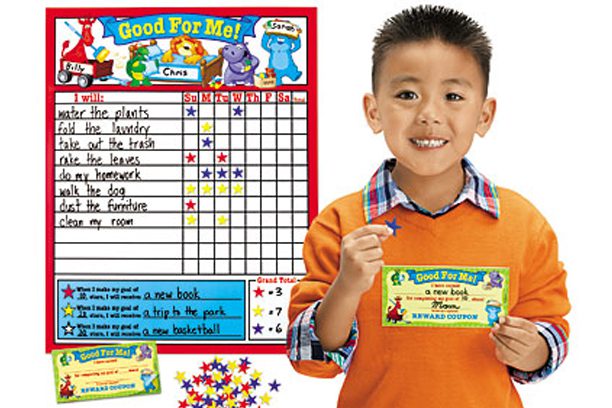
Good for Me Reward Kit

Rewarding kids for good behavior is a way to minimize negative behaviors and encourage more positive ones. I like this chart because you can write in the behaviors and what a child earns for the stars earned.

It is good to start with only a few behaviors for younger kids. For older children, you can write 6-8 behaviors. Also, try one behavior you know your child can do, one that is a little of a reach but he/she can do, and one that he/she hasn’t done yet, but you would like to see. In the beginning it is good for the child to get a few stars easily. It helps get them invested in the system. Lastly, behaviors on the chart must be positive. Avoid giving a star for not hitting brother, for not spitting food out, for not making a mess. Instead reward for catching child being nice to brother, eating food with good manners, and for cleaning up.

Some good examples of behavior for the chart would be: Put clothes in laundry basket, hang up book bag, good table manners, listens the first time asked, does a good job on homework, and helps a parent with a chore. Choose items that you feel you are always nagging your child to do.

Toddler Temper Tantrums

Toddler Temper Tantrums


So your previously delicious angel has turned into a screaming, biting, head banging, little trouble maker. Here is the good and the bad news. As children become more secure with their attachment to their parents they begin exploring their environment wanting independence. The good news is that as your child pushes him/herself to do more difficult tasks he/she will develop a strong self-esteem as well as learn to dress oneself, put on shoes, brush teeth, spread the butter on toast, etc. The bad news is that it can be frustrating to be a little guy/girl who wants badly to be able to make choices and do for himself but can’t always do so.

Toddlerhood, while difficult for children, can be brutal for the accompanying adult. However, there are ways to not only get through this time, but to grow as parents and children. Here are some tips that you can begin as soon as the first tantrum rears its ugly head:

  • Manage your schedule so that you leave extra time for everything. Rushing just doesn’t work for toddlers.
  • Plan less and accomplish more. The more you put on your plate and the plate of your toddler, the more opportunities there are for your plans to be thwarted by tantrums.
  • Before you say no to your toddler who asks to do something for himself, think first if you can let him try. It is better to let your toddler try to put his shoes on and fail then it is to tell him he can’t do it. If you aren’t hovering and waiting to jump in there he will probably eventually ask you for help.
  • This might sound like a cliché, but choices are very powerful. Whenever you can give your child a choice it is best because it makes him feel like he has some control over his environment.
  • No matter how carefully you tread, you cannot avoid all tantrums. Sometimes little people are irrational. The best way to deal with an irrational, screaming child is to ignore him. No matter what, don’t give in. Sometimes the tantrum has to run its course with the child not getting his way to realize that a tantrum is not an appropriate way to get what he wants. If you give in to just end the screaming (which I know is insanely tempting), it only reinforces to the child that this act works.
  • Remember that this is a phase. Your child isn’t trying to harass you or make your life more difficult. He is just trying to grow up.


Waiting at home…

Waiting at home…


Sending my daughter off to sleep-away camp was something I never questioned. It is what I did, and my sisters, and all of my cousins. It was the best time in my year and I learned half of what I know from my summers away. I can start a fire, put up a tent, canoe, sail, water ski, be independent, be a friend, a leader, a follower, and push myself to do something embarrassing. Most important, I learned to deal with people who I may not always like. Our head counselor, Helene Lebowitz, used to say “Girls, you don’t have to like each other, but you have to get along.” Helene taught me one of my most valuable lessons. I never forgot her or the lesson. I wanted my kids to have the same experience.

Basking in the glowing memories of my camp experience, it never occurred to me that I would be at home suffering and desperately missing my daughter. I wonder if she is getting any sleep. Did she make friends? Is she eating anything healthy? Did she find her toothbrush? Is she changing out of her bathing suit when it’s wet? Is she using a clean towel for the shower and not the yucky one from the lake? Did she get up on skies? What is she doing right now? How about now? What about now? You get the point.

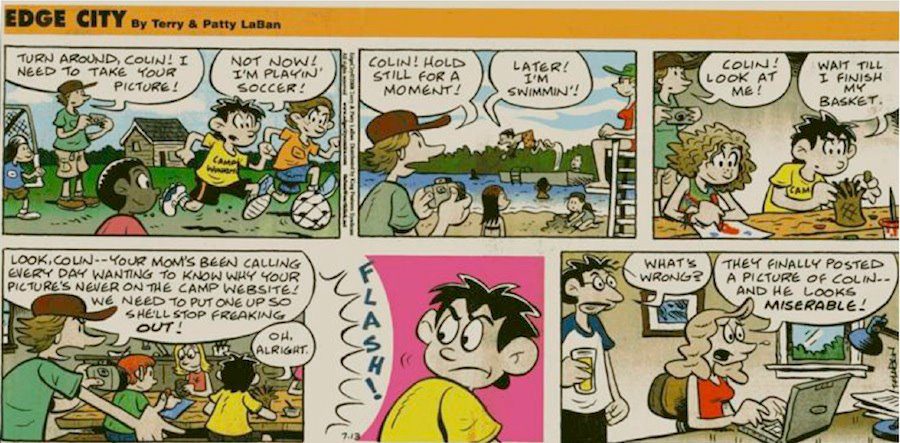
To make my obsession even more voracious, the camps post photos of the kids. Parents pour over these photos waiting for a glimpse of a happy camper. This cartoon really makes me laugh because it is so true. Anyone who has sent their kids off to sleep-away camp can relate. Enjoy and try to laugh.

A cartoon strip with several different scenes and one of the comic strip is written in yellow.